

Freshwater Pond Treatment: 2 Acres
High nutrient levels and accumulated organic matter can significantly reduce water clarity in freshwater ponds.
When excess nutrients enter a pond, they can create eutrophic conditions that promote rapid algae growth. As algae and other organic material accumulate, pond water may become cloudy, develop unpleasant odors, and experience declining overall water quality.
Excess organic biomass can also interfere with pond infrastructure by clogging:
- Irrigation pump intakes
- Aeration equipment
- Water circulation systems
- Recreational water features
Managing Nutrients and Organic Solids with Bioaugmentation
Municipalities and other organizations that rely on freshwater ponds for irrigation, recreation, or water storage may benefit from biological treatment strategies designed to manage accumulated organic solids.
Bioaugmentation introduces selected populations of beneficial bacteria into the pond to support the biological breakdown of organic material.
These microorganisms may help:
- Reduce accumulated organic solids
- Support nutrient management
- Improve pond water clarity
- Reduce conditions that promote excessive algae growth
- Improve overall freshwater pond quality
Bioaugmentation can be especially useful during seasonal periods when nutrient concentrations increase and contribute to algae and organic solids accumulation.
Using ProBiotic Scrubber® II PAO for Pond Treatment
The following case study describes the use of BioLynceus® ProBiotic Scrubber® II PAO (PBII PAO) to address water clarity problems in a 2-acre irrigation and recreational water-feature pond.
PBII PAO contains a diverse microbial community that includes phosphorus-accumulating organisms (PAOs) designed to support phosphorus management and biological treatment.
The treatment program focused on reducing organic solids, managing excess nutrients, and improving overall pond water clarity and biological conditions.
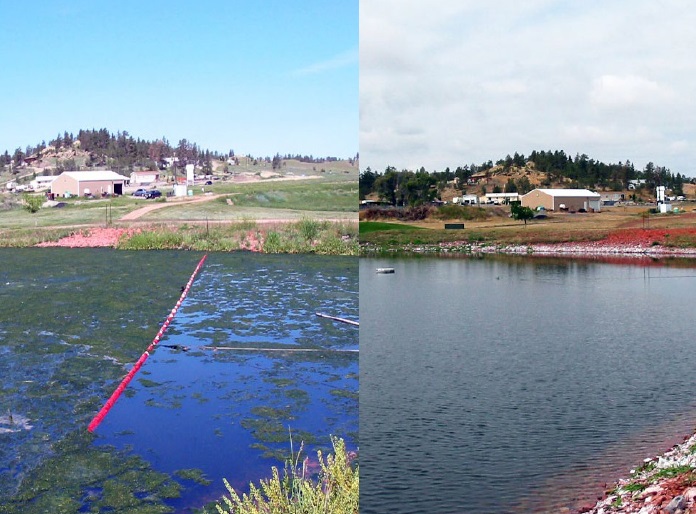
Figure 1. Case study pond in May before daily applications of PBII PAO (left) and in September, after four months of daily treatment (right).
Water Clarity Problems in a 2-Acre Golf Course Pond
A golf course in Montana was having difficulty maintaining water clarity in a 2-acre freshwater irrigation pond.
Each spring, rising water temperatures increased biological activity within the pond. Microorganisms began breaking down accumulated organic solids, which released nutrients back into the water column.
The pond also received water from a local wastewater treatment plant. This source contributed additional nutrients, creating conditions that promoted excessive algae growth.
Algae Growth Creates Irrigation and Odor Problems
As algae and suspended organic material increased, the golf course experienced several operational problems.
The algae frequently clogged irrigation pump intakes. During the spring and summer months, maintenance crews had to remove and service the pumps four to five times per week.
The pond also developed unpleasant odors that affected golfers and maintenance personnel.
Golf course management needed a biological treatment strategy that could help:
- Reduce accumulated organic solids
- Manage excess nutrients
- Control conditions that promoted algae growth
- Improve pond water clarity
- Reduce irrigation equipment maintenance
- Minimize unpleasant odors
The Golf Course Superintendent contacted BioLynceus® for assistance.
Treating the Pond with ProBiotic Scrubber® II PAO
The pond was inoculated with ProBiotic Scrubber® II PAO (PBII PAO) at the end of the growing season in September.
PBII PAO contains a diverse consortium of beneficial bacteria designed to support organic solids decomposition and nutrient management.
The following spring, golf course management observed less algae growth than in previous years.
Based on these results, the facility began applying PBII PAO daily and continued treatment until the pond froze during the winter.
Improved Water Clarity and Reduced Pump Maintenance
Within approximately four months, algae growth on the pond surface decreased and water turbidity improved.
The irrigation pumps also clogged less frequently.
Before treatment, the pumps required servicing four to five times each week. Following treatment, maintenance was reduced to approximately once per month.
The pond also experienced:
- Improved water clarity
- Reduced odors
- Less algae growth
- Fewer clogged pump intakes
- Lower irrigation system maintenance requirements
- Improved recreational appearance
Irrigation Water Supports Healthier Turf
The treatment program also produced an unexpected benefit in the turf irrigated with pond water.
Golf course management observed healthier and greener grass following treatment.
Bacteria carried in the irrigation water helped break down organic material within the turf thatch layer, supporting improved movement of nutrients and water into the root zone.
During the study, the treated turf reportedly required:
- 30% less irrigation water
- 50% less fertilizer
These reductions were accompanied by improved turf appearance and overall plant health.
Continued Pond Treatment Improves Water Clarity
The golf course continued using PBII PAO during the following year.
Daily treatment during the second season produced additional improvements in pond clarity as biological activity continued to reduce layers of accumulated organic and algal material on the pond bottom.
Eventually, the pond's red shale liner became visible through approximately 12 feet of water.
The BioLynceus® bioaugmentation program helped reduce accumulated organic material and manage nutrient availability, resulting in improved overall freshwater pond conditions.
Improve Freshwater Pond Clarity with ProBiotic Scrubber® II PAO
BioLynceus® ProBiotic Scrubber® II PAO is designed to support freshwater pond clarity, organic solids reduction, nutrient management, algae control, and biological water treatment.